I got an A! Yay! This is the first A, straight up, no qualifiers, that I have received in Latin graduate school, and I actually feel like I deserved it. I think this blog helped enormously. I have spent the past several years trying to find the most productive and best way for me to translate and study, and nothing quite seemed to work for me. I asked a few professors, and they were less than unhelpful. I'll never forget my Fall professor saying, "Don't work so hard. Just do it better." which made me want to thwack him. But the process I developed for this blog has been working wonderfully. I feel like my Latin improved more this last semester than in the two years before.
The Process
1. Copying the Latin text from The Latin Library to my blog.
2. Taking it a sentence at a time, I list the words I don't recognize and need to look up.
3. Look up the words.
4. Translate the passage into English and write down the translation in the blog.
5. Check my translation against another's translation to see if I missed anything major.
6. Correct my English translation if necessary.
7. Translate in class from the Latin, using my English translation as a backup if necessary.
I could, if I need to know it even better, write out the translations of the words I needed to look up, and then re-translate the whole thing from Latin by sight. The above method is the minimum, though, and by doing it that way, I was able to translate both familiar and unfamiliar passages well enough on the exams to get As on both tests. That is the first time it's happened. What a blessing this experience was and continues to be.
Showing posts with label apuleius. Show all posts
Showing posts with label apuleius. Show all posts
Thursday, June 30, 2011

Thursday, May 26, 2011
Cupid and Psyche 2
In Which It's Enough to Give a Goddess a Complex
[29] Sic immensum procedit in dies opinio, sic insulas iam proxumas et terrae plusculum provinciasque plurimas fama porrecta pervagatur. iam multi mortalium longis itineribus atque altissimis maris meatibus ad saeculi specimen gloriosum confluebant. Paphon nemo, Cnidon nemo ac ne ipsa quidem Cythera ad conspectum deae Veneris navigabant; sacra praetereuntur, templa deformantur, pulvinaria proteruntur, caerimoniae negleguntur; incoronata simulacra et arae viduae frigido cinere foedatae. puellae supplicatur et in humanis vultibus deae tantae numina placantur, et in matutino progressu virginis victimis et epulis Veneris absentis nomen propitiatur, iamque per plateas commeantem populi frequenter floribus sertis et solutis adprecantur.
Thus this belief grew to enormous proportions day by day, and thus the story stretched out and spread out immediately to the nearby islands and then somewhat to the provinces on the mainland. Now many of the mortal men were flowing together on long journeys and through deep-see voyages to the glorious Face of the Century.
No one was sailing to Paphos, no one to Cnidos, and not even to Cythera itself to see the goddess; her sacred rites were cast aside, her temples left to ruin, her couches crushed underfoot, and her ceremonies neglected. Her statues were ungarlanded and her altars shamefully bereft with frigid ashes of fires gone out.
Prayers were directed to the girl, and in her human face the powers of the whole goddess were appeased. At the appearance of the maiden each morning, with feasts and sacrifices, the name of the absent Venus was celebrated. And now the people beseeched the young girl with garlands and scattered flowers whenever she walked through the streets.
 |
| What is this about some other girl? |
[29] Sic immensum procedit in dies opinio, sic insulas iam proxumas et terrae plusculum provinciasque plurimas fama porrecta pervagatur. iam multi mortalium longis itineribus atque altissimis maris meatibus ad saeculi specimen gloriosum confluebant. Paphon nemo, Cnidon nemo ac ne ipsa quidem Cythera ad conspectum deae Veneris navigabant; sacra praetereuntur, templa deformantur, pulvinaria proteruntur, caerimoniae negleguntur; incoronata simulacra et arae viduae frigido cinere foedatae. puellae supplicatur et in humanis vultibus deae tantae numina placantur, et in matutino progressu virginis victimis et epulis Veneris absentis nomen propitiatur, iamque per plateas commeantem populi frequenter floribus sertis et solutis adprecantur.
Thus this belief grew to enormous proportions day by day, and thus the story stretched out and spread out immediately to the nearby islands and then somewhat to the provinces on the mainland. Now many of the mortal men were flowing together on long journeys and through deep-see voyages to the glorious Face of the Century.
No one was sailing to Paphos, no one to Cnidos, and not even to Cythera itself to see the goddess; her sacred rites were cast aside, her temples left to ruin, her couches crushed underfoot, and her ceremonies neglected. Her statues were ungarlanded and her altars shamefully bereft with frigid ashes of fires gone out.
Prayers were directed to the girl, and in her human face the powers of the whole goddess were appeased. At the appearance of the maiden each morning, with feasts and sacrifices, the name of the absent Venus was celebrated. And now the people beseeched the young girl with garlands and scattered flowers whenever she walked through the streets.
Wednesday, May 25, 2011
Cupid and Psyche 1
 |
| Apparently Longfellow had three daughters as well. |
In Which We Meet Our Heroine
Sunday, May 22, 2011
Bibliographies for Authors of the Second Sophistic
 |
| One of life's greatest tragedies is opportunity cost. |
One of the benefits of my recent class was a weekly presentation on a different author whose works we were NOT reading in class. It gave context to the author we were studying and it was great to learn what I don't know. Good thing there's a long life - there's a lot to cover. The presentations were interesting, and I suspect the most lasting contribution may be the bibliographies. If I'm ever bored and don't know what to study, I'll start here.
Below the cut are bibliographies for the following authors:
- Achilles Tatius
- Athenaeus
- Favorinus
- Fronto
- Lucian
- Macrobius
- Maximus of Tyre
- Philostratus
- Pliny the Elder
- Pliny the Younger
- Quinutus of Smyrna
- Seneca the Elder
Thursday, May 19, 2011
Metamorphoses: The Character of Our Hero
Lucius is the young, wealthy and curious protagonist of Apuleius’s Metamorphoses. Over the course of the book, Lucius undergoes a physical and emotional journey and emerges a humbler version of his essential self: a kind, compliant, and curious young man.
In Book One, also known as the Prologue to the main story, we meet Lucius, who meets two fellow travelers while on the road to Thessaly. We don’t learn of his name until Book Two, and the information we learn then contradicts the information the narrator presents of himself in Book One. For the purposes of this essay, I will adopt Apuleius’s method and present all the information and the readers decide for themselves which of the contradictory stories is true.
In Book One, also known as the Prologue to the main story, we meet Lucius, who meets two fellow travelers while on the road to Thessaly. We don’t learn of his name until Book Two, and the information we learn then contradicts the information the narrator presents of himself in Book One. For the purposes of this essay, I will adopt Apuleius’s method and present all the information and the readers decide for themselves which of the contradictory stories is true.
Monday, May 16, 2011
Exegesis of 3.3-5
In which Katie breaks down the interesting aspects of Metamorphoses 3.3b-5
And in which Katie decides to start introducing posts in the manner with which Charles Dickens introduced chapters in Oliver Twist.
And in which Katie decides to start introducing posts in the manner with which Charles Dickens introduced chapters in Oliver Twist.
Tuesday, May 10, 2011
Metamorphoses 11.23 - Lucius has a religious experience
 |
| It is very difficult to Google for "vision of heaven". |
- This is the only time we get a description of the initiation into the cult of Isis. What is more interesting is what he doesn't mention.
- Lucius loves this - the guy who was so interested in magic has thrown himself into religious mysteries wholeheartedly.
- He addresses the reader! In the prologue to the book the narrator did, but Lucius is a character in the story the narrator is telling, and then he breaks the fourth wall! This is a very chic, post-modern book. I can't believe it was written in 130ish AD.
Monday, May 9, 2011
A note about Apuleius and my class
One more passage of the Metamorphoses and my translation adventures with Apuleius will be over for the nonce. I do have two projects left: the paper and the take home final. I was supposed to write the paper over the weekend, but instead I spent those two days sleeping, blowing my nose, and laughing at Arrested Development. I made some notes, but that's it. So the paper is this week's project. This summer will be another topic, but I haven't decided what. Probably Catullus's poetry, in which I learn how to do meter in Latin. It's completely different than in English, and making my brain learn how will be the summer's challenge. I'll be taking my first Latin poetry class this fall and I need to know meter before it starts.
It'll be great. Catullus is the source of some of the greatest love poetry ever written.
It'll be great. Catullus is the source of some of the greatest love poetry ever written.
Wednesday, May 4, 2011
Metamorphoses 11.22 - Holy books
 |
| Apparently all the presently available holy scrolls are of Eastern religions. That does make sense - the cult of Isis herself was an Eastern religion. |
- Running out of time. These are twice as long as normal - it's taking me an hour apiece.
- My dictionary doesn't know what a teleta is. Which means I don't. UPDATE: It means an initiation. It's a Greek word, which I should have known. This is an Eastern religion.
- I skipped the paragraph describing the books. I really don't like ekphrases.
Metamorphoses 11.21 - "Slow down, cowboy"
 |
| It doesn't matter the religion, the new guy needs a trainer. |
- inferi means "those beneath". So to mortals, the inferi are the dead. To the gods, the inferi are us.
- traditionem, from which we get "tradition", means surrender. Huh. That looks like something worth looking up in the OED.
- The priest actually sounds like he knows what he's talking about, and I like his patience and his shared sympathy for the challenges of discipleship.
- Oh my stars, this was ONE CHAPTER. And it took me an hour and a half. This week's assignment is going to get down to the wire, I think.
Tuesday, May 3, 2011
Metamorphoses 11.14-15
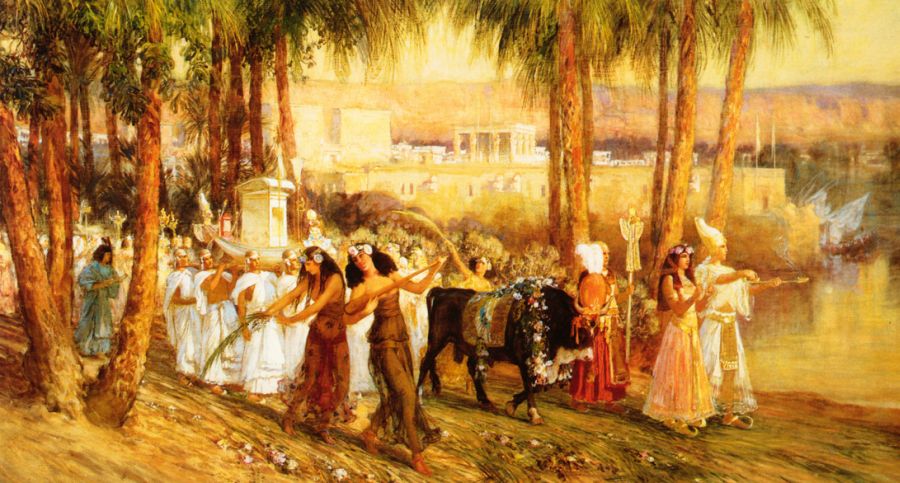 |
| Procession in Honor of Isis, painted in the late 1800s. |
- More of Isis vs. Fate - this time, it seems that Isis defeated Fate on behalf of Lucius. Very interesting, that. Maybe worth exploring.
- As Isis saved Lucius, it seems that she claims him as her own slave. That word in particular is used a couple of times. Lucius must become a priest (sacerdos) of Isis to repay her for his freedom.
- It's the last line I find interesting - the idea that in service to God we find freedom is not an unfamiliar one. Since this was written during the Second Sophistic, right around the time that the Christians and their funny, cultish, new religion was getting attention, I'd be very interested to see where and when this idea permeated. I haven't read it in any previous Latin literature, although that's no guarantee it wasn't there, of course. Maybe I just haven't seen it.
- Even in the midst of these miracles. Apuleius can't help making Lucius a little bit of a ridiculous figure. Him standing there with no clothes is a scene that has appeared in a dozen cartoons, deservedly so. It's hilarious.
Wednesday, April 27, 2011
"Israfel" by Edgar Allen Poe
In Heaven a spirit doth dwell
"Whose heart-strings are a lute";
None sing so wildly well
As the angel Israfel,
And the giddy stars (so legends tell),
Ceasing their hymns, attend the spell
Of his voice, all mute.
Tottering above
In her highest noon,
The enamored moon
Blushes with love,
While, to listen, the red levin
(With the rapid Pleiads, even,
Which were seven,)
Pauses in Heaven.
And they say (the starry choir
And the other listening things)
That Israfeli's fire
Is owing to that lyre
By which he sits and sings-
The trembling living wire
Of those unusual strings.
But the skies that angel trod,
Where deep thoughts are a duty-
Where Love's a grown-up God-
Where the Houri glances are
Imbued with all the beauty
Which we worship in a star.
Therefore thou art not wrong,
Israfeli, who despisest
An unimpassioned song;
To thee the laurels belong,
Best bard, because the wisest!
Merrily live, and long!
The ecstasies above
With thy burning measures suit-
Thy grief, thy joy, thy hate, thy love,
With the fervor of thy lute-
Well may the stars be mute!
>Yes, Heaven is thine; but this
Is a world of sweets and sours;
Our flowers are merely–flowers,
And the shadow of thy perfect bliss
Is the sunshine of ours.
If I could dwell
Where Israfel
Hath dwelt, and he where I,
He might not sing so wildly well
A mortal melody,
While a bolder note than this might swell
From my lyre within the sky.
Thursday, April 14, 2011
Wednesday, April 13, 2011
Metamorphoses 4.23-24
 |
| Stolen while dressing for her wedding. That is a TERRIBLE wedding day. |
- The girl that gets brought in is clearly high class.
- She also obviously thinks so. When she laments what she's lost, she mentions her house and her slaves before her parents.
- Apuleius puts the highest rhetoric and most erudite speech in the mouth of the child bride. Interesting.
- We won't translate what happens to her, but while she survives this present calamity, things go very, very south for her later. But things go south for everyone Lucius encounters eventually
Monday, April 11, 2011
Metamorphoses 3.24
- I didn't translate all that I was supposed to last week because I was preparing for my presentation on Wednesday. However, this paragraph is amazing, and it's worth looking at again.
- My prof brought up in class the question of Photis's motives. I just KNEW her attitude was fishy.
- This is a hilarious passage. I'm not translating everything literally - this is a family blog.
- Since this is done quick and I'm getting better at Apuleius, I'm not making the table like I did for the other passages.
 |
| Man accidentally turns into a donkey? That happens a LOT in literature. Even this story wasn't the first - it's a retelling of an older Greek story. |
Wednesday, April 6, 2011
Metamorphoses 3.16
 |
| Undoubtedly this is where Photis's story took place. |
- So this chasing after young men - and sending her slave to do it - is not a new habit of the magical woman.
- Interesting that apparently her habits are well known. I need to finish reading those books on magic in the classical world to know how reluctantly magical women were tolerated.
- Photis is laying on the flattery pretty thick. I can't remember this part of the book well - I almost wonder if she is under orders. Lucius is apparently a good-looking guy, but is he really worth abandoning her escape plan?
Friday, April 1, 2011
Metamorphoses 3.15
 |
| 1868 Painting of Medea, a "witch" from antiquity. Love made her fearsome, like several other characters from that time. |
- Photis's act with the strap and the tears was really something. Lucius is now putty in this girl's hands, and I almost have to admire how she mixes flattery with fear to coax from him his natural curiosity.
- A witch who preys upon young, good-looking men...there is a trope in there, I am sure of it. Erika would know better. Part of what makes the mulier so disturbing is the control that she is credited with - not only does she control men, but she controls the stars, the gods, the very elements. It doesn't matter what she does with it - a woman with that kind of power in that time would automatically be labeled a witch, no matter the source of the power.
Tuesday, March 29, 2011
Metamorphoses 3.13-14
Thoughts about this passage:
- Apparently nothing cures a crying jag like the chance to impress a girl. Lucius continues to be an emo playboy.
- After translating the last paragraph, it occurs to me that I might not post the next passage on the blog.
- More of curiosity and caring leading to...something. Lucius is driven by his desires and pursues them indiscriminately, and Metamorphoses seems to be of the "curiosity killed the cat" mindset. This desire for Photis is going to go badly for him.
Friday, March 25, 2011
Metamorphoses 3.12: "Seriously, I still have to go to the dinner party?"
 | ||
| A Roman bathroom from the ruins of Pompeii; the best place, even then, to recover from a good cry. |
- Sadly, I don't have many. The passage's translation was spread out over four days, because my niece is visiting me, and I can't remember now what I was thinking before.
- Okay, I do notice, again, how very human and vulnerable Lucius seems. It makes his excesses and bad choices later more sympathetic.
- I told my niece not to let me go to sleep until I finished my homework for today. She held me to it. She's so much a better student than me, even at 11.
Tuesday, March 22, 2011
Metamorphoses 3.10-11
 |
| I had no idea there were so many words for "cry" in Latin. |
Notes on these passages:
- Lucius is not a hero here. I kind of like how he's in shock and tears after thinking it was all over for him.
- But he recovers once obeisance is given to his family. He was supposed to be related to Plutarch - I think it's funny how Apuleius picked a literary luminary rather than a monetary or political figure.
Subscribe to:
Posts (Atom)